How to Start a Manifestation Journal: Steps, Prompts and a Template
In short: A manifestation journal is a notebook where you write down your intentions, what you are grateful for, and what you want to hold more calmly. It is a writing practice, not a promise of results. To start one, you need four simple steps: name an intention and check it, practise trust, write down gratitude, and make room for stillness. This guide shows each step, with prompts and a template.
Most people who start a manifestation journal begin with a list of wishes. A new job. More money. The right person. After a week the list is still there, and so is the feeling that nothing has moved.
The problem is rarely the wishing. It is everything around it: the wish we borrowed from someone else, the fear we never wrote down, the checking and doubting that follow every intention. A good journal makes room for all of that. Here is a simple way to start one.
What is a manifestation journal?
A manifestation journal is a notebook, paper or digital, where you write your intentions and reflect on them regularly. Some people write every morning, others a few times a week. What makes it a manifestation journal is the focus: what you want to bring into your life, and what in you stands for or against it.
Our own approach comes from a simple observation that runs through many ancient texts. The restless part of us swings between wanting and fearing. We want something badly, then fear we will never get it, then want it again. A journal is a place to stop that swing for a few minutes, look at it honestly, and write from a calmer place. That is the perspective behind this guide, not a scientific claim.
How to start a manifestation journal in 4 steps
You need nothing more than a notebook and ten to fifteen minutes. Each entry follows the same four steps.
Step 1. Name an intention, then check it
Write one intention in a single, short sentence. Start it with “I intend” rather than “I want”: a want is a feeling, an intention is a decision. Then check it with three questions:
- Is it truly mine? Or did I borrow it from my parents, my friends, or a screen?
- Does it hide a fear or a negative? “I intend to stop being broke” still keeps being broke at the center. Name what you want, not what you are running from.
- Does it limit how it can come true? “I intend to be promoted at this company” assumes the answer is this company. Often what you really want is larger.
If any answer gives you pause, rewrite the sentence until it is clear, simple and yours.
Step 2. Practise trust
Under your intention, write down what is outside your control: other people’s choices, timing, the economy. Then write one line that lets it go, such as “I have set my intention; the rest is not mine to carry today.” Trust, in this practice, means you stop checking every hour whether it has happened yet.
Step 3. Write down gratitude
List three things you are grateful for today. Keep them specific: not “my family” but “the call from my sister this morning.” Wanting more and being grateful for what you have are not opposites. A journal is where you can hold both.
Step 4. Make room for stillness
Before you close the notebook, sit for one minute in silence with your intention. Do not push it, and do not analyse it. Just hold it, the way you would hold a warm cup in your hands. If worry comes, notice it and come back to the intention.
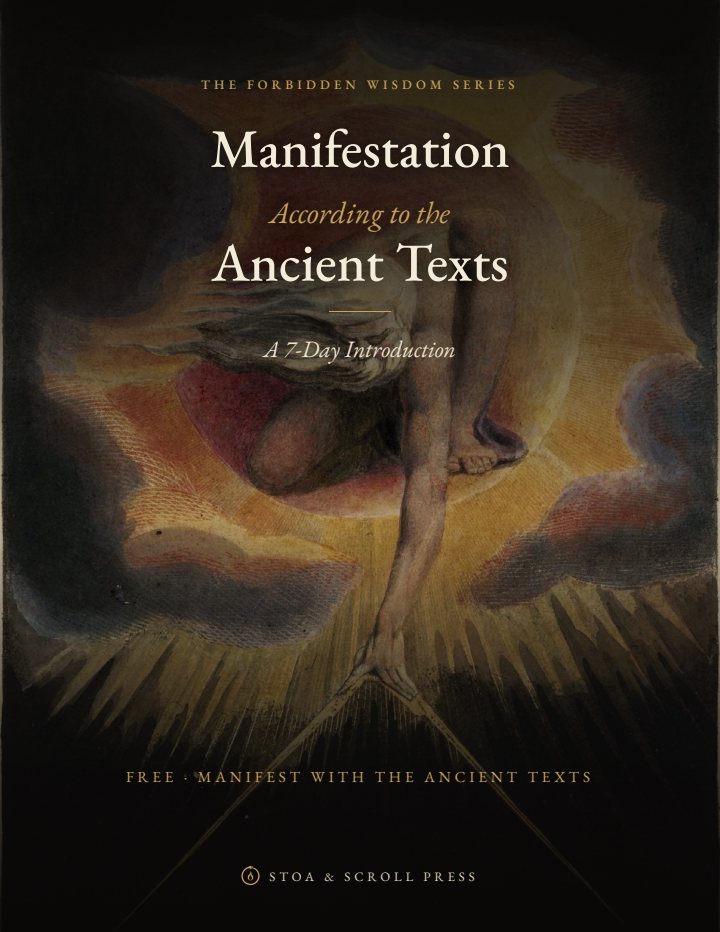
Seven days with the Corpus Hermeticum, the Emerald Tablet, the Kybalion and the Gospel of Thomas. One passage a day, a note on what it meant, and a writing page for your intention. A free PDF.
Manifestation journal prompts to get you started
Prompts help when you open the notebook and do not know what to write. These come from our free 7-day manifestation journal and its complete edition. Choose one a day.
For your intention
- What do you truly want right now? Ask, wait for the answer, then ask what is behind it.
- Which of your goals did you choose, and which did you inherit?
For what stands in the way
- Which “I can’t” do you repeat most often? Where did you first learn it?
- Write your intention. Then write, honestly, the fear on the other end of the rope.
- What do you look at most each day? What is it making you into?
For trust, gratitude and stillness
- Where do you keep checking, doubting, wavering? What would it look like to treat the matter as settled?
- Write ten things you already have that you once asked for, or would miss if they were gone.
And one prompt from a very old source. The Gospel of Truth, an early Christian text found at Nag Hammadi in Egypt, describes waking from a nightmare: “they abandon them like a dream in the night” (translated by Mark M. Mattison). Write down one fear that might look different if you saw it as a dream you are about to wake from.
Is there a manifestation journal template?
Yes. A simple manifestation journal template has five parts, one for each step plus the date. You can copy it into any notebook, or use it as the layout of a digital page. Spend two or three minutes on each part.
| Section | What to write | Example prompt |
|---|---|---|
| Date | Today’s date | Which day of my journal is this? |
| Intention | One sentence, starting with “I intend” | Is it truly mine? Does it hide a fear or a limit? |
| Trust | What is outside your control, and a line that lets it go | What am I still trying to control? |
| Gratitude | Three specific things | What would I miss if it were gone? |
| Stillness | One minute of silence, then one line about how you feel | What did I notice when I stopped? |
If you would rather start with a printed layout, our free 7-day manifestation journal has a writing page for every day, built on this structure.
What is scripting in manifestation?
Scripting is a writing exercise in which you describe something you want as if it has already happened. You write in the present tense, with detail, as a short scene from the life you intend: “I open the door of my new apartment. The light comes in from the left…” It is a modern practice, common in today’s manifestation communities. It does not come from the ancient texts.
To try it as a writing exercise:
- Choose one intention you have already checked (Step 1).
- Write five to ten sentences in the present tense, as if it is real today.
- Include ordinary details: where you are, what you see, what you do next.
- Write with calm rather than urgency. If you notice yourself straining, stop, and come back to Step 4.
Scripting is a way of making an intention concrete on the page. We do not claim that it makes anything happen, and you should be wary of anyone who promises that it will.
Where do manifestation ideas come from?
The phrase “law of attraction” is modern. It grew out of New Thought, a movement that spread through the United States in the late nineteenth and early twentieth centuries and taught that thoughts shape health, success and circumstance. In 1906, William Walker Atkinson published Thought Vibration, or the Law of Attraction in the Thought World. Two years later came The Kybalion, often attributed to him, which presented similar ideas as ancient Hermetic teaching. We explain what it says, and what is really ancient in it, in The 7 Hermetic Principles.
The ancient texts themselves were doing something different. The Hermetic writings of Roman Egypt describe a universe held in Mind and teach the seeker to know God, not to attract things. But their insight into the mind, how it forgets itself, swings between opposites and finds rest, is exactly what makes them good company for a journal.
Questions about manifestation journaling
Does scripting help with manifestation?
Scripting is a writing practice. Many people find that it helps them make an intention concrete and notice how they feel about it. There is no evidence that it produces outside results on its own, and this guide does not claim that it does.
How often should I write in a manifestation journal?
As often as you can keep it up. A short entry every day is easier to sustain than a long one once a month. Ten to fifteen minutes, following the four steps, is enough.
Can I keep a manifestation journal on my phone?
Yes. A notes app or a digital journal works, as long as you can write without distractions. Many people still prefer paper, because it slows them down.
Writing what you want is the easy part. Writing honestly about what stands in the way, and then sitting still with it, is where a journal starts to change the one who keeps it.