The 7 Hermetic Principles: What the Kybalion Says and Where They Come From
In short: The seven hermetic principles are Mentalism, Correspondence, Vibration, Polarity, Rhythm, Cause and Effect, and Gender. They come from The Kybalion, a book published anonymously in 1908 under the name “Three Initiates” and often attributed to William Walker Atkinson. The book presents them as ancient Hermetic teaching. Two of them echo genuinely ancient texts. The rest are a modern formulation, close to the New Thought movement of its time.
“As above, so below.” “All is mind.” “Everything vibrates.” You have probably met these phrases on social media, in books about manifestation, or in a friend’s favorite quote. They are usually presented as wisdom from ancient Egypt, passed down from Hermes Trismegistus himself.
The truth is more interesting. Most of them come from a single book printed in Chicago in 1908. Some of its ideas really do reach back to the ancient Hermetic writings. Others were new. Here is what each principle says, and where it comes from.
What are the 7 hermetic principles?
The seven hermetic principles are the seven “laws” of the universe set out in The Kybalion: Mentalism, Correspondence, Vibration, Polarity, Rhythm, Cause and Effect, and Gender. According to the book, they work on every plane of existence, physical, mental and spiritual, and a person who understands them can master moods, thoughts and circumstances.
Here are the seven hermetic principles in the Kybalion’s own words, with what we can say about their roots.
| Principle | What the Kybalion says | Older roots |
|---|---|---|
| Mentalism | “THE ALL IS MIND; The Universe is Mental.” | Echoes the Corpus Hermeticum, where God is Mind |
| Correspondence | “As above, so below; as below, so above.” | Adapted from the Emerald Tablet |
| Vibration | “Nothing rests; everything moves; everything vibrates.” | No clear source in the ancient Hermetic texts |
| Polarity | “Everything is Dual; everything has poles; everything has its pair of opposites.” | No clear source in the ancient Hermetic texts |
| Rhythm | “Everything flows, out and in; everything has its tides; all things rise and fall.” | No clear source in the ancient Hermetic texts |
| Cause and Effect | “Every Cause has its Effect; every Effect has its Cause.” | No clear source in the ancient Hermetic texts |
| Gender | “Gender is in everything; everything has its Masculine and Feminine Principles.” | Loosely echoes the Poimandres, where Mind is “both male and female” |
The seven principles, one by one
1. Mentalism: “The All Is Mind”
The first principle says that the reality behind everything, which the book calls THE ALL, is Mind, and that the universe exists within it as a mental creation. It is the foundation of the whole book: if the universe is mental, then changing the mind changes how a person meets the world. This is the principle with the strongest ancient echo, as we will see below.
2. Correspondence: “As Above, So Below”
The law of correspondence says that the same patterns repeat on every level of existence, so that by studying one plane you can understand another. The Kybalion takes its maxim from the Emerald Tablet, a short and mysterious text attributed to Hermes, and the phrase “as above, so below” has followed it ever since. We trace that phrase back to its source in As Above, So Below: Where It Comes From and What It Really Means.
3. Vibration: “Everything Vibrates”
The law of vibration says that everything is in motion, and that the differences between matter, energy, mind and spirit are differences in their rate of vibration. The Kybalion claimed that modern science endorsed this idea. That was the book’s claim in 1908, not a finding of science, and it should be read as part of the book’s own era.
It is also the principle most closely tied to the modern idea of manifestation. Two years before the Kybalion, William Walker Atkinson had published Thought Vibration, or the Law of Attraction in the Thought World (1906). The language of “vibration” and “attraction” came from that same circle of writers. If you are interested in what the ancient texts themselves say about the mind and intention, we gathered the original passages in a free journal, Manifestation According to the Ancient Texts.
4. Polarity: “Everything Is Dual”
Polarity says that opposites are the same thing in different degrees: hot and cold, light and dark, love and hate, courage and fear. “All truths are but half-truths,” the book says, and “all paradoxes may be reconciled.” Its practical teaching is that a person can move their own mind along the scale, from fear toward courage, instead of trying to destroy the fear.
5. Rhythm: “Everything Flows, Out and In”
Rhythm says that everything moves like a pendulum: tides rise and fall, moods swing, nations and lives have their seasons. The Kybalion adds a teaching it calls the Law of Neutralization: the master “polarizes himself at the point at which he desires to rest” and lets the swing pass beneath him, instead of being carried to the other extreme.
6. Cause and Effect: “Every Cause Has Its Effect”
This principle says that nothing happens by chance, only by laws we do not yet see. Most people, the book says, are carried along by circumstances and by the wishes of others, “like pawns on the Chessboard of Life.” The student learns to rise to a higher plane and become a cause instead of an effect.
7. Gender: “Gender Is in Everything”
The last principle says that a masculine and a feminine principle are at work in everything, on every plane. The Kybalion is clear that it does not mean physical sex. It uses gender for two creative forces, one that projects and one that receives and gives form, and it applies the idea to the mind as much as to nature.
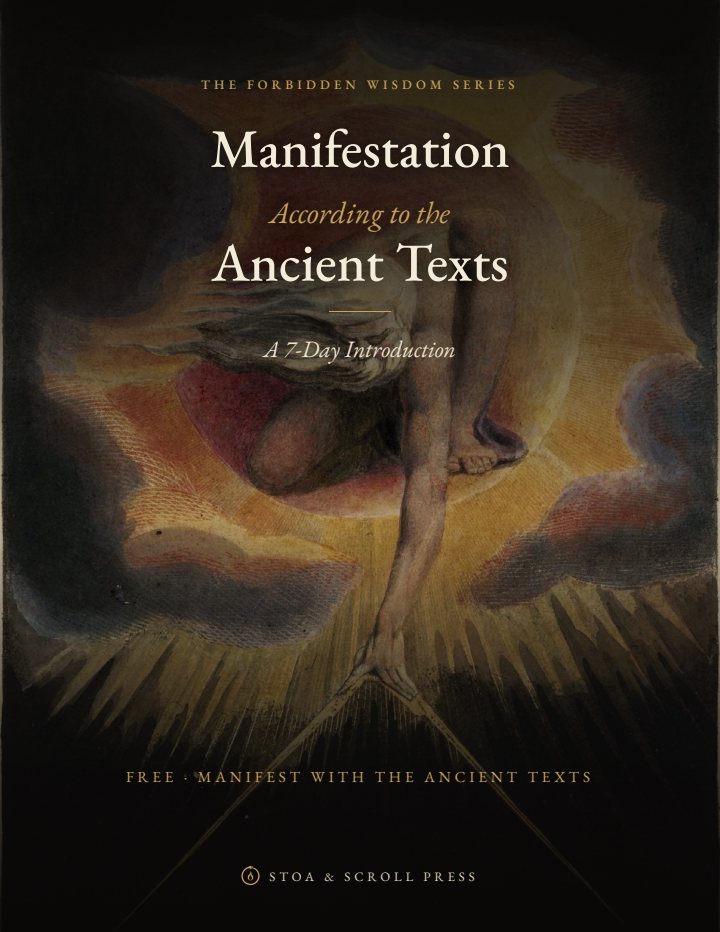
Seven days with the Corpus Hermeticum, the Emerald Tablet, the Kybalion and the Gospel of Thomas. One passage a day, a note on what it meant, and a writing page for your intention. A free PDF.
What is the Kybalion and who wrote it?
The Kybalion is a short book published in Chicago in 1908, signed only “Three Initiates.” It presents itself as a study of Hermetic philosophy, built around a secret collection of maxims that it quotes in italics. The author never revealed their name. The book is often attributed to William Walker Atkinson, a prolific writer of the New Thought movement, although this has never been proven beyond doubt.
New Thought was a movement that spread through the United States in the late nineteenth and early twentieth centuries. It taught that thoughts shape health, success and circumstance. Read with that in mind, the Kybalion looks like what it probably is: a New Thought book that gave its ideas the authority of Hermes Trismegistus.
That does not make it worthless. It has been in print for more than a century, and for many readers it is their first meeting with the name of Hermes. But it is a modern book, and it deserves to be read as one.
Is the Kybalion actually Hermetic?
Partly. Two of its seven principles have real ancient roots, and the idea at the heart of the book is genuinely Hermetic. But most of its maxims are not found in the older Hermetic writings, and the formulation as seven laws is modern. As the introduction to the Kybalion in our edition puts it, apart from its version of the Emerald Tablet’s “as above, so below,” none of its quoted maxims has been found in the older Hermetic writings.
Here is what does have ancient roots.
The universe as Mind. The Corpus Hermeticum, a collection of Greek treatises written in Roman Egypt in the first centuries of our era, describes God as Mind. In its eleventh treatise, Mind teaches Hermes to think of God “as having all things in himself as thoughts, the whole Cosmos itself.” That is very close to the Kybalion’s first principle, although the ancient text speaks of knowing God, not of mastering circumstances.
As above, so below. The Emerald Tablet, known from Arabic sources and later treasured by alchemists, says it this way in Isaac Newton’s translation: “That which is below is like that which is above and that which is above is like that which is below to do the miracles of one only thing.” The Kybalion’s second principle is a free version of this line.
Male and female. In the Poimandres, the first treatise of the Corpus Hermeticum, “God, who is Mind, being both male and female” brings the world into being. The Kybalion’s principle of Gender is much more elaborate, but this is the closest ancient echo.
The principles of Vibration, Polarity, Rhythm and Cause and Effect have no clear source in the ancient Hermetic texts. They read much more like the ideas of their own time.
The best way to see the difference is to read them side by side. The Hermetic Texts (Volume III of the Forbidden Wisdom Series) prints the original 1908 Kybalion without changes, next to the ancient Corpus Hermeticum, the Asclepius and the Emerald Tablet, adapted from the classic translations of G.R.S. Mead and Isaac Newton.
Who was Hermes Trismegistus?
Hermes Trismegistus, “thrice-great Hermes,” is the legendary sage to whom the Hermetic writings are attributed. He combines the Greek god Hermes with the Egyptian god Thoth, the god of writing and wisdom. Ancient readers often treated him as a real teacher of great antiquity. Scholars today see the name as a symbolic attribution: the Hermetic texts were written by several unknown authors, mostly in the first centuries of our era. You can read more about the figure in Britannica’s entry on Hermes Trismegistus.
Questions about the hermetic principles
What is Hermeticism?
Hermeticism is the tradition built on the writings attributed to Hermes Trismegistus, above all the Corpus Hermeticum and the Asclepius. These texts teach that God is Mind, that the human mind shares in the divine, and that knowledge of God is the goal of life. They were rediscovered in Renaissance Florence and influenced alchemy, astrology and Western esoteric thought for centuries.
Are the 7 hermetic principles ancient?
Not as a set. The seven principles were first gathered and named in The Kybalion in 1908. Two of them, Mentalism and Correspondence, have clear ancient roots in the Corpus Hermeticum and the Emerald Tablet. The others are a modern formulation.
Is the Kybalion the same as the Emerald Tablet?
No. The Emerald Tablet is a short, much older text attributed to Hermes, known from Arabic sources. The Kybalion is a modern book from 1908 that quotes one idea from it, “as above, so below,” and builds a whole system around it. You can read all fourteen lines, in Newton’s translation and in modern English, in The Emerald Tablet of Hermes: The Real Text and Newton’s Translation.
What does the Kybalion have to do with the law of attraction?
Both grew from the same movement. The Kybalion is often attributed to William Walker Atkinson, who in 1906 published Thought Vibration, or the Law of Attraction in the Thought World. Much of today’s language of manifestation, “all is mind,” “everything vibrates,” comes from this circle of New Thought writers.
The seven principles are not an ancient secret. They are a modern doorway into a very old room. Walk through it, and read what is really inside.