The Emerald Tablet of Hermes: The Real Text and Newton’s Translation
In short: The Emerald Tablet is a short text of fourteen lines attributed to Hermes Trismegistus. It is known from Arabic versions of the late eighth or early ninth century and a Latin translation of the twelfth, and it became the founding text of Western alchemy. Its second line, “what is below is like what is above,” is the source of the saying “as above, so below.” Below you can read it in Isaac Newton’s translation and in modern English.
Few texts this short have travelled so far. The Emerald Tablet fits on a single page, yet alchemists copied it for centuries, Isaac Newton translated it by hand, and one of its lines became a saying that people now print on posters and tattoo on their skin.
It is also one of the most confused texts on the internet. Search for it and you will find videos about Atlantis, a book about Thoth, and a dozen different versions of the words. This guide gives you the real text, where it came from, and what it is not.
What is the Emerald Tablet?
The Emerald Tablet is a short, cryptic text attributed to Hermes Trismegistus, the legendary sage of Hermetic tradition. Its earliest known versions are in Arabic, in works from the late eighth or early ninth century. Translated into Latin in the twelfth century, it became the founding text of Western alchemy.
In fourteen lines, it describes a single “one thing” from which all things come, born of the Sun and the Moon, carried by the wind and nursed by the earth. It tells the reader to separate the subtle from the gross, and it promises that whoever understands this work will have “the glory of the whole world.” Alchemists read it as a recipe for the philosophers’ stone. Philosophers read it as a description of how the universe is made. It can be read as both, and that is part of its power.
Where did the Emerald Tablet come from?
No one knows who wrote it. The name “Hermes Trismegistus,” Hermes the Thrice-Great, belongs to a legendary figure, born from the meeting of the Greek god Hermes and the Egyptian god Thoth, to whom many ancient writings were attributed.
The oldest surviving forms of the Tablet are Arabic, and they credit its discovery to Balinas, the Arabic name for Apollonius of Tyana. The legend varies. In one version, the Tablet was found in a chamber beneath a statue of Hermes; in others, in the tomb of Hermes himself.
In the twelfth century the Tablet was translated into Latin, and from then on it was copied, quoted and explained by almost every alchemist in Europe. The Latin is the version most English translations follow, but it is not identical to the Arabic. In 2025, the scholar Joseph Azize published what he describes as the first full English translation of the Arabic text known to him, in the journal Literature & Aesthetics of the University of Sydney, and found substantial differences between the two.
Isaac Newton and the Emerald Tablet
Isaac Newton is remembered for gravity and calculus, but he spent years of his life on alchemy, and he left more than a million words on the subject in his private papers. Among them is his own English translation of the Emerald Tablet, made from the Latin, with notes of his own. The manuscript is now at King’s College, Cambridge, and you can see its record in the Newton Project of the University of Oxford, which dates it to between the early 1680s and the 1690s.
Here is the whole Tablet, line by line, in Newton’s words (with his spelling modernized) and in the modern English version from our edition.
| Line | Isaac Newton’s translation | In modern English |
|---|---|---|
| 1 | Tis true without lying, certain and most true. | It is true, without falsehood, certain and most true. |
| 2 | That which is below is like that which is above and that which is above is like that which is below to do the miracles of one only thing. | What is below is like what is above, and what is above is like what is below, to accomplish the miracles of the one thing. |
| 3 | And as all things have been and arose from one by the mediation of one: so all things have their birth from this one thing by adaptation. | And as all things have come from the One, through the mediation of the One, so all things are born from this one thing by adaptation. |
| 4 | The Sun is its father, the moon its mother, the wind hath carried it in its belly, the earth is its nurse. | The Sun is its father, the Moon its mother; the wind has carried it in its belly; the earth is its nurse. |
| 5 | The father of all perfection in the whole world is here. | Here is the father of all perfection in the whole world. |
| 6 | Its force or power is entire if it be converted into earth. | Its power is complete if it is turned into earth. |
| 7 | Separate thou the earth from the fire, the subtle from the gross sweetly with great industry. | Separate the earth from the fire, the subtle from the gross, gently and with great skill. |
| 8 | It ascends from the earth to the heaven and again it descends to the earth and receives the force of things superior and inferior. | It rises from earth to heaven, and descends again to earth, and receives the power of things above and things below. |
| 9 | By this means you shall have the glory of the whole world and thereby all obscurity shall fly from you. | By this means you will have the glory of the whole world, and all darkness will flee from you. |
| 10 | Its force is above all force, for it vanquishes every subtle thing and penetrates every solid thing. | Its power is above all power, for it overcomes every subtle thing and penetrates every solid thing. |
| 11 | So was the world created. | So the world was created. |
| 12 | From this are and do come admirable adaptations where of the means is here in this. | From this come wonderful adaptations, and the way to them is here. |
| 13 | Hence I am called Hermes Trismegist, having the three parts of the philosophy of the whole world. | That is why I am called Hermes Trismegistus, having the three parts of the philosophy of the whole world. |
| 14 | That which I have said of the operation of the Sun is accomplished and ended. | What I have said about the work of the Sun is complete and ended. |
Read this way, the Tablet is less mysterious than its reputation. It describes a process: something rises and descends, joins above and below, and gains power from both. Whether that process happens in a furnace or in a human soul is the question every reader has to answer.
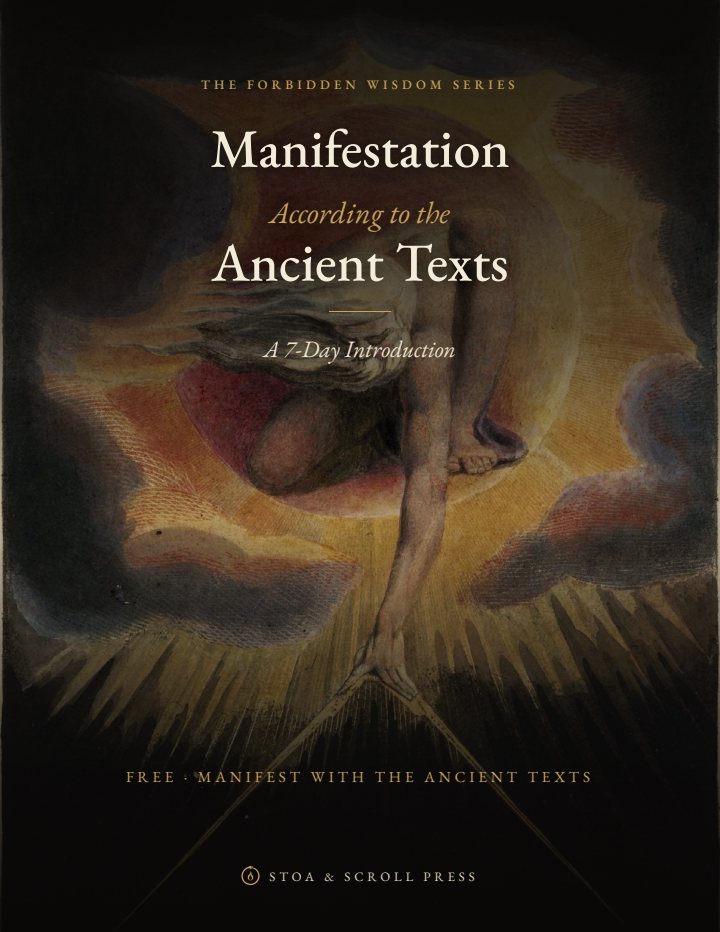
Seven days with the Corpus Hermeticum, the Emerald Tablet, the Kybalion and the Gospel of Thomas. One passage a day, a note on what it meant, and a writing page for your intention. A free PDF.
“As above, so below”: where the saying comes from
The most famous words connected with the Tablet are not exactly in it. The Tablet says that “what is below is like what is above, and what is above is like what is below.” The short form “as above, so below” is a later summary of that line, made popular by modern occult writers.
Its best-known use is in The Kybalion of 1908, which made it the Principle of Correspondence, the second of its seven Hermetic principles. The idea is that the same laws work at every level of reality, so that by understanding one level you can understand another. For a full look at the phrase, read As Above, So Below: Where It Comes From and What It Really Means, and for the Kybalion’s system, see The 7 Hermetic Principles.
The “Emerald Tablets of Thoth”: is it the same text?
No. The Emerald Tablets of Thoth the Atlantean is a different book, first published in the twentieth century by an American esoteric teacher who called himself Doreal. It presents itself as a translation of tablets left by Thoth, a priest-king of Atlantis, and it runs to many pages of visions and teachings.
No ancient manuscript of it is known, and it does not appear in any Arabic, Greek or Latin source. The Emerald Tablet of Hermes, by contrast, is the short text above, with a history that can be traced through medieval manuscripts. Many readers value Doreal’s book on its own terms, but it should not be confused with the text Newton translated.
Questions about the Emerald Tablet
Is the Emerald Tablet real?
As a text, yes. The Emerald Tablet survives in real medieval Arabic and Latin manuscripts, and scholars have studied it for more than a century. What is legendary is its origin: there is no evidence that Hermes wrote it, or that it was ever carved on an emerald.
Where is the original Emerald Tablet?
There is no physical tablet in any museum. The “tablet” is the text itself, which has come down to us only in copies, first in Arabic books and later in Latin manuscripts. The story of an emerald slab found in a chamber or a tomb belongs to the legend, not to the evidence.
What does the real Emerald Tablet say?
The real Emerald Tablet contains fourteen short lines about the work of “one thing,” whose father is the Sun and whose mother is the Moon. It teaches that what is below is like what is above, tells the reader to separate the subtle from the gross, and promises “the glory of the whole world.”
Who wrote the Emerald Tablet?
No one knows. It is attributed to Hermes Trismegistus, but that is a traditional attribution, not a historical author. Its earliest known form is Arabic, from the late eighth or early ninth century.
The Emerald Tablet asks very little of its reader: a few minutes, and a willingness to look at the sky and at oneself as parts of the same work. That may be why, after more than a thousand years, people are still reading it.