The Book of Jubilees: What It Says, Who Wrote It, and Why It’s Not in the Bible
In short: The Book of Jubilees is an ancient Jewish book, written in Hebrew around the second century BC, that retells Genesis and the first part of Exodus as a revelation given to Moses on Mount Sinai. It divides history into “jubilees” of 49 years, defends a calendar of 364 days, and adds stories Genesis never tells, including the fall of the Watchers and the demon prince Mastema. It is part of the Bible of the Ethiopian Orthodox Church, but not of the Jewish, Catholic or Protestant Bible.
Moses is on Mount Sinai for forty days. Everyone knows he came down with the tablets of the law. The Book of Jubilees asks a different question: what else was he told up there?
Its answer is the entire history of the world, from the first day of creation to the night of the exodus, dictated to Moses by an angel and dated to the year. Ancient readers called it “the Little Genesis.” It is not little at all. It is one of the boldest retellings of the Bible ever written, and for centuries almost no one in the West could read it.
What is the Book of Jubilees about?
The book opens on Sinai. God tells Moses to write down everything he will hear, and an “angel of the presence” begins to dictate from the heavenly tablets, the records kept in heaven since the beginning.
What follows is the story of Genesis, told again with new details on almost every page:
- Creation. The angels are created on the first day, and the Sabbath is kept in heaven before any human keeps it.
- Eden. Adam and Eve live in the garden for seven years before they are driven out.
- The Watchers. Angels come down to teach humanity, then sin with human women. Their children are the giants, and the flood follows.
- Noah and the evil spirits. After the flood, evil spirits torment Noah’s grandchildren, and an angel teaches Noah how to heal with plants.
- Abraham. As a boy he turns away from his father’s idols. At sixty, he gets up in the night and burns the house where they are kept.
- Jacob, Joseph and Moses. Rebecca becomes a central figure, Jacob a model of faithfulness, and the story ends with the exodus from Egypt.
The book has fifty chapters. Every event in it is dated by jubilees, periods of forty-nine years, and by “weeks” of seven years. History, for this author, is not a jumble of events. It is a clock, and heaven keeps the time.
Who wrote the Book of Jubilees, and when?
The book claims to be written by Moses, from an angel’s dictation. Scholars agree that it was actually written by a Jewish author, or a circle of authors, probably in the second century BC. The writer knew Genesis well, knew the Enoch traditions, and cared deeply about the priesthood, the Sabbath and the purity of Israel.
It was written in Hebrew. Fragments of more than a dozen copies were found among the Dead Sea Scrolls at Qumran, which shows how widely it was read. One of the Qumran texts, the Damascus Document, even refers to it as the book that divides the times “into their jubilees and their weeks.”
The complete text survives only in Ge’ez, the classical language of Ethiopia, with parts preserved in Latin and in quotations by Greek writers.
Is the Book of Jubilees in the Bible?
Only in one Bible. The Ethiopian Orthodox Tewahedo Church includes Jubilees in its Bible, together with the Book of Enoch, and still reads it today.
It is not in the Jewish Bible. It is not in the Catholic Bible, and it is not among the Apocrypha found in some Protestant Bibles either. Scholars place it among the “pseudepigrapha,” ancient books written in the name of a great figure of the past.
So, like Enoch, Jubilees was not “removed” from the Bible. It was never included in most Bibles to begin with, like many of the lost books of the Bible. The reasons are much the same: it was not part of the scriptures that Jewish tradition settled on, and the claim that Moses wrote it was hard to accept. Its strict calendar, which did not match the one used in the Temple, may also have kept it on the margins. You can read the full story of how this happened to Enoch in Why Is the Book of Enoch Not in the Bible?
Is the Book of Jubilees mentioned in the Bible?
No. No book of the Bible names it.
Some readers see a faint echo in the New Testament, which says that the law was given “by the disposition of angels” (Acts 7:53) and “ordained by angels” (Galatians 3:19). Jubilees tells exactly that story: an angel speaking to Moses on the mountain. But that idea was shared by many Jews of the time, so it does not prove that the apostles knew the book.
Does the Book of Jubilees contradict the Bible?
It does not reject Genesis. It retells it. But it changes the emphasis, and some of those changes are striking.
The clearest example is the binding of Isaac. In Genesis, God tests Abraham. In Jubilees, the test begins with a challenge from the prince of the evil spirits, much like the opening of the Book of Job:
“See, Abraham loves Isaac his son, and he delights in him above all other things. Tell him to offer him as a burnt offering on the altar, and you will see if he will do this command.”
When Abraham proves faithful, the angel says simply: “The prince Mastema was put to shame.”
Jubilees also insists that the patriarchs kept the Sabbath and the festivals long before Moses, and that the Watchers first came down with a good purpose. In this version, they descended “so that they should instruct the children of men, and that they should do judgment and uprightness on the earth.” Only later did they fall.
Whether these differences are contradictions depends on how you read them. For the author, they were not changes at all. They were the hidden meaning of the story, written on the tablets of heaven.
Two hundred angels, an oath on Mount Hermon, and the book the Bible quotes but does not contain. Enter your email and we will send you all 36 chapters of the Book of the Watchers in clear modern English, as a free PDF.
Who is Mastema in the Book of Jubilees?
Mastema is the chief of the evil spirits, and one of the most unsettling figures in ancient literature.
After the flood, the spirits of the dead giants begin to lead Noah’s grandchildren astray. Noah prays, and God orders the angels to bind them all. Then Mastema steps forward and asks for a share:
“Lord, Creator, let some of them remain before me, and let them listen to my voice and do all that I say to them.”
God agrees, but only in part: “Let the tenth part of them remain before him, and let nine parts descend into the place of condemnation.”
From then on, Mastema appears behind many of the dark moments of the story. He sends clouds of ravens to devour the seed in the fields, until Abraham, a boy of fourteen, turns them back. He provokes the test of Abraham. He even tries to kill Moses on the road back to Egypt.
There is something strangely hopeful in this picture. Evil is real in Jubilees, and it is organized. But it is limited. Nine parts of it were bound. It works only by permission, and it does not have the last word.
The Jubilees calendar: 364 days
If one idea drives the whole book, it is time.
Jubilees teaches that the true year has exactly 364 days, which is fifty-two weeks. In such a year, every date and every festival falls on the same day of the week, year after year. The angel commands Moses:
“Command the children of Israel to observe the years according to this reckoning: three hundred and sixty-four days, and these will make up a complete year.”
The book warns that if people follow the moon instead, they will “confuse all the days, the holy with the unclean.” This was not a small technical matter. In the second century BC, Jews argued bitterly about the calendar, and the community at Qumran followed a 364-day year much like this one.
Behind the numbers is a beautiful idea: that time itself is holy, and that keeping the right days is a way of living in step with heaven.
Enoch, Jubilees and Jasher
Many readers look for the Books of Enoch, Jubilees and Jasher together, because they are often sold in one volume. Enoch and Jubilees belong together naturally. They are both ancient, both found among the Dead Sea Scrolls, both part of the Ethiopian Bible, and Jubilees draws directly on the Enoch stories.
The Book of Jasher is a different case. The Bible mentions a “book of Jasher” (Joshua 10:13), but that book is lost. The Book of Jasher sold today is a much later Hebrew work, first printed in the 1600s.
Why the Book of Jubilees still matters
It is easy to read Jubilees as a book about dates and rules. But underneath, it is a book about trust.
Its author lived in a time of pressure, when many of his people were giving up their customs to fit into the world around them. His answer was to show that everything, from the first Sabbath to the smallest festival, had been kept in heaven since the beginning. Nothing was random. No day was empty. Even evil had its limits.
That is a hard thing to believe when your own world feels out of order. Perhaps that is exactly why he wrote it down.
Read the Book of Jubilees
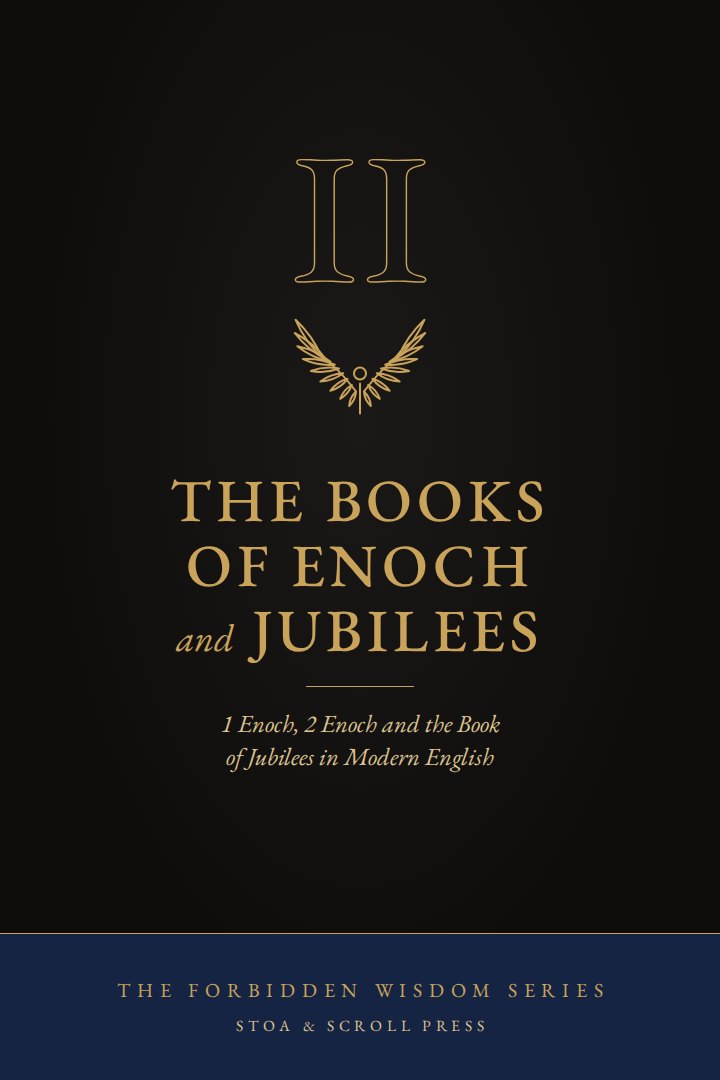
The complete Book of Jubilees, all fifty chapters, is in The Books of Enoch and Jubilees, Volume II of the Forbidden Wisdom Series, together with 1 Enoch and 2 Enoch, in clear modern English with an introduction to each book.
The story of the Watchers that Jubilees retells is told in full in Who Were the Watchers and the Nephilim?, and you can read the opening of the Book of Enoch free.