Why Is the Book of Enoch Not in the Bible?
In short: The Book of Enoch was never removed from the Bible, because most Bibles never included it. Jewish tradition did not count it among its scriptures, and the churches of the West set it aside in the early centuries, doubting that it truly came from Enoch and uneasy with its story of angels taking human wives. Only the Ethiopian and Eritrean Orthodox churches kept it, and it is still in their Bible today.
Near the end of the New Testament, the short Letter of Jude quotes a prophecy:
“And Enoch also, the seventh from Adam, prophesied of these, saying, Behold, the Lord cometh with ten thousands of his saints, to execute judgment upon all.” (Jude 1:14-15)
Those words come from the Book of Enoch. And yet, if you open almost any Bible, the Book of Enoch is not there. A book the Bible quotes as prophecy, left outside the Bible itself.
How did that happen? The answer is not a conspiracy, and it is not a single decision. It is a slow story of trust, doubt and forgetting.
Was the Book of Enoch ever in the Bible?
It depends on whose Bible you mean.
In Ethiopia, yes. The Ethiopian Orthodox Tewahedo Church has kept the Book of Enoch in its Bible for well over a thousand years, together with the Book of Jubilees. The Eritrean Orthodox Church does the same. For millions of Christians today, Enoch is scripture.
In the Jewish Bible, no. The Hebrew scriptures that Jewish tradition settled on never included it.
In most Christian Bibles, no, but it came close. In the first centuries, many Christians read it with deep respect. Copies were found among the Dead Sea Scrolls, so Jewish readers in the time of Jesus knew it well. The Epistle of Barnabas, an early Christian letter, quotes it as scripture. Around the year 200, Tertullian of Carthage argued that it should be accepted.
So the word people often use, “removed,” is not quite right. The Book of Enoch was never taken out of the Catholic, Orthodox or Protestant Bible. It was simply never let in, and over time it stopped being read at all.
Why was the Book of Enoch left out of the Bible?
Ancient writers left us their reasons, and they come down to three.
1. Doubt about who wrote it. The book claims to record the visions of Enoch, who lived before the Flood. Many church leaders found it hard to believe that a book from that far back could have survived. In the early fifth century, Augustine wrote in The City of God that the book was too ancient, and its origin too uncertain, to be trusted as scripture.
2. It was not in the Jewish scriptures. The first Christians inherited their Old Testament from Jewish tradition, and Enoch was not part of it. Tertullian himself admitted that some Christians rejected the book for exactly this reason, even as he argued for it.
3. Its story of the angels. The book teaches that the “sons of God” in Genesis 6 were angels who came down and took human wives. Over time, many Christian teachers came to prefer another reading: that the “sons of God” were simply the descendants of Adam’s son Seth. As that view spread, Enoch’s version became an embarrassment. Jerome even noted that some Christians doubted the Letter of Jude itself, because it quoted Enoch.
Once the churches stopped reading it in worship, scribes stopped copying it. The Greek and Latin copies slowly disappeared. In the West, the Book of Enoch survived for more than a thousand years only as a name and a few quotations, until the Scottish traveler James Bruce brought complete copies home from Ethiopia in 1773.
Did Jesus quote the Book of Enoch?
No saying of Jesus in the gospels quotes the Book of Enoch word for word. The one clear quotation in the New Testament is in the Letter of Jude.
But some of the closest echoes are in the words of Jesus. In the part of Enoch called the Book of Parables, a heavenly figure called the Son of Man sits in judgment. The kings of the earth tremble “when they see that Son of Man sitting on the throne of his glory.” In the Gospel of Matthew, Jesus says:
“When the Son of man shall come in his glory, and all the holy angels with him, then shall he sit upon the throne of his glory.” (Matthew 25:31)
There is another echo. In Enoch, God tells the fallen angels that he never gave them wives, because “the spiritual ones of heaven have their dwelling in heaven.” In Matthew 22:30, Jesus says that in the resurrection people “neither marry, nor are given in marriage, but are as the angels of God in heaven.”
Scholars still debate what these parallels mean. The Book of Parables is hard to date, and both texts may draw on ideas that were simply in the air. What is certain is that Jesus and his first followers lived in a world where the Book of Enoch was known, read and discussed.
Two hundred angels, an oath on Mount Hermon, and the book the Bible quotes but does not contain. Enter your email and we will send you all 36 chapters of the Book of the Watchers in clear modern English, as a free PDF.
Why do some people say to stay away from the Book of Enoch?
If you search for the Book of Enoch, you will find warnings. Most of them come from sincere places, and they are worth hearing:
- It is not scripture for most churches. For many Christians, reading it as if it were the Bible would be a mistake.
- Its author is not Enoch. Scholars agree that it was written by several Jewish authors between about the third century BC and the time of Jesus, not by a man who lived before the Flood.
- Its contents are strange. Giants, named angels, journeys to the ends of the earth, long calculations of the sun and moon. Some readers find it confusing or unsettling.
- It is often misused. Online, the book is pulled into theories about aliens, hidden bloodlines and secret giants that it never teaches.
All of that is fair. But there is a difference between treating a book as scripture and reading it to understand history. The Letter of Jude quoted it. The first Christians knew it. Without it, several passages of the New Testament, like the angels “in chains” of 2 Peter and Jude, are hard to understand at all.
The safest way to read the Book of Enoch is the honest way: as an ancient Jewish book, written by people trying to answer real questions about evil, judgment and the fate of the world.
Is the Book of Enoch scripture?
For the Ethiopian and Eritrean Orthodox churches, yes. For Judaism and for the Catholic, Protestant and Eastern Orthodox churches, no. The Ethiopian canon keeps other books too: see The Ethiopian Bible.
But “not scripture” does not mean “not worth reading.” The Book of Enoch is one of the most important books for understanding the world of the New Testament. It shaped how Jews and Christians imagined angels, demons, the judgment and the life to come. And it asks a question that every generation asks again: if the world was made good, where did all this evil come from?
You do not have to accept its answer. But it is hard to read it and not feel the weight of the question.
Read the Book of Enoch for yourself
The best way to decide what you think is to read it. You can read the opening chapters free, the Book of the Watchers, in clear modern English.
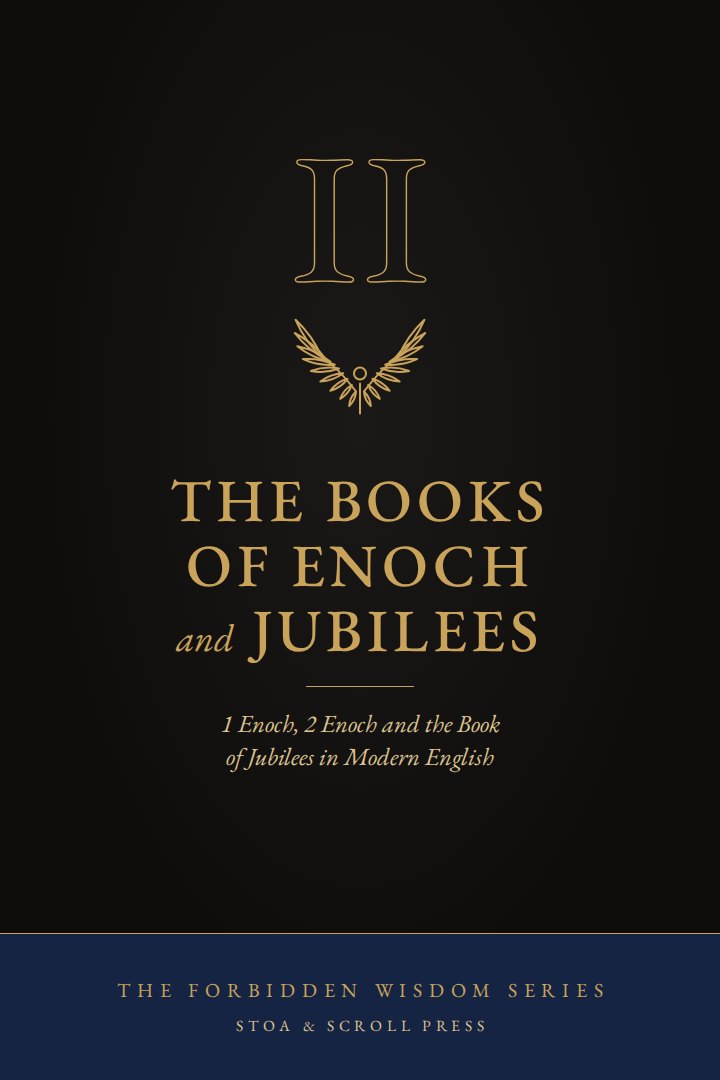
The complete 1 Enoch, along with 2 Enoch and the Book of Jubilees, is in The Books of Enoch and Jubilees, Volume II of the Forbidden Wisdom Series, with an introduction to each part.
New to the book? Start with What Is the Book of Enoch?, or read the story of the fallen angels in Who Were the Watchers and the Nephilim?