What Is the Ethiopian Bible? Its Books, Its Canon, and What It Preserved
In short: The Ethiopian Bible is the biblical canon of the Ethiopian Orthodox Tewahedo Church. It is wider than any other Christian canon and includes books such as 1 Enoch and the Book of Jubilees, which survive complete only in Ge’ez, the classical language of Ethiopia. Tradition speaks of 81 books, though the lists that reach that number differ.
For most of history, Western scholars knew the Book of Enoch only by name. Then, in 1773, the Scottish traveller James Bruce came back from Ethiopia with copies of the complete text in Ge’ez. A book that Europe had lost for more than a thousand years had been read, copied and treasured all along in the highlands of the Horn of Africa.
That is the Ethiopian Bible in one story: not a different faith, but a different memory of what scripture is.
Why is the Ethiopian Bible different?
Ethiopia became Christian early and developed its church far from Rome and Constantinople. According to historians, the kingdom of Aksum adopted Christianity in the 4th century, and the Bible was translated into Ge’ez over the following centuries. Isolated from the debates that shaped Western canons, the Ethiopian church kept Jewish writings that the earliest Christians read and others let go.
The traditional account names Frumentius, a Syrian Christian who came to the court of Aksum and was later made its first bishop by Athanasius of Alexandria. Under King Ezana, Christianity became the faith of the court. For more than 1,500 years after that, the Ethiopian church looked to the Coptic church of Alexandria for its bishops, and only received its own patriarch in 1959.
The Bible was translated into Ge’ez mostly from Greek, probably between the 4th and 6th centuries, although the exact dates are still debated. Ge’ez is no longer spoken in daily life, but it is still the language of the liturgy, much as Latin once was in the West. Manuscripts of these books are still being catalogued today by projects such as Beta maṣāḥǝft at the University of Hamburg, which lists dozens of copies of the Ethiopic Enoch alone.
The church also has a different sense of what a canon is. In his study of the Ethiopian canon, the scholar R.W. Cowley noted that “the concept of canonicity is regarded more loosely than it is among most other churches.” Some books are read in worship, others are used for teaching and church order, and the lists vary from one manuscript to another. For the background on why Western churches made the opposite choice about Enoch, see Why Is the Book of Enoch Not in the Bible?
How many books are in the Ethiopian Bible?
Ethiopian tradition speaks of “the 81 books”. But the number has been reached in more than one way, and that is why you will see different counts.
Cowley described two main lists. The narrower canon counts 54 books in the Old Testament and the usual 27 in the New Testament. It is found in the church’s prayer book and in the large Bibles printed by imperial command, and its books are the ones Cowley described as undisputed. The broader canon counts 46 books in the Old Testament and 35 in the New. It drops some books and adds others, mostly works of church order. Both lists add up to 81, but they are not the same 81.
| List | How it counts | Notable additions |
|---|---|---|
| Narrower canon | 54 Old Testament + 27 New Testament | 1 Enoch, Jubilees, plus the books Catholics call deuterocanonical |
| Broader canon | 46 Old Testament + 35 New Testament | Sinodos, the Book of the Covenant, Ethiopic Clement, the Didascalia, Josippon |
The books of the narrower canon
Here is the narrower canon as it is usually listed, grouped the way most Bibles group their books. The order and the names vary from one manuscript to another, so take it as a common arrangement, not the only one.
- The Law (5): Genesis, Exodus, Leviticus, Numbers, Deuteronomy.
- History and other books (23): Joshua, Judges, Ruth, 1 and 2 Samuel, 1 and 2 Kings, 1 and 2 Chronicles (with the Prayer of Manasseh), Jubilees, Enoch, 1 Ezra, Nehemiah, 3 Ezra, Ezra Sutuel (4 Ezra), Tobit, Judith, Esther, 1, 2 and 3 Meqabyan, Job, Psalms.
- Wisdom (6): Messale (Proverbs 1 to 24), Tagsas (Proverbs 25 to 31), Wisdom of Solomon, Ecclesiastes, Song of Songs, Sirach.
- Prophets (20): Isaiah, Jeremiah, Baruch, Lamentations, the Letter of Jeremiah, 4 Baruch (the Paralipomena of Jeremiah), Ezekiel, Daniel, and the twelve minor prophets, from Hosea to Malachi.
- New Testament (27): the same 27 books as in other Christian Bibles.
That makes 54 books in the Old Testament and 27 in the New. Proverbs is counted as two books, which is one of the reasons the totals differ from other Bibles. The broader canon adds Josippon and books of church order: the Sinodos, the Book of the Covenant, Ethiopic Clement and the Didascalia.
You will also find the number 88 in printed editions and online lists. It does not match either of the two traditional lists, and the scholarly studies of the canon do not use it. Part of the confusion is that the same book can be counted, named or divided in different ways. As Cowley put it, “the naming of a book in a list does not necessarily uniquely identify it.” The honest answer is that there is no single number accepted everywhere, and 81 is the number the tradition itself uses.
A few of these books exist nowhere else. The three books of Meqabyan carry the name of the Maccabees but are not the same as any of the Greek books of Maccabees: they are Ethiopian works that survive only in Ge’ez. Josippon is a history of the Jews based on Josephus. The Sinodos, the Book of the Covenant, Ethiopic Clement and the Didascalia are books of church order and teaching, presented as instructions from the apostles.
The “lost books” preserved in Ethiopia
Many of the books people today call the lost books of the Bible were never lost in Ethiopia. They were part of a living tradition, read in churches and copied in monasteries generation after generation. Two of them matter more than any others.
The Book of Enoch in the Ethiopian Bible
1 Enoch, called Maṣḥafa Henok in Ge’ez, is the book of the Watchers, the angels who came down to earth, and of Enoch’s journeys through heaven. The Ethiopian church considers it inspired scripture. It survives complete only in Ge’ez, and the Letter of Jude in the New Testament quotes it directly (Jude 1:14–15).
The book was probably written in Aramaic, and Aramaic fragments of it were found among the Dead Sea Scrolls. But without the Ethiopian copies, we would have only pieces. After Bruce brought the manuscripts to Europe, Richard Laurence published the first English translation in 1821, and R.H. Charles produced the classic translation from the Ethiopic in the early 20th century. To learn what the book says, start with What Is the Book of Enoch? and Who Were the Watchers and the Nephilim?
Two hundred angels, an oath on Mount Hermon, and the book the Bible quotes but does not contain. Enter your email and we will send you all 36 chapters of the Book of the Watchers in clear modern English, as a free PDF.
The Book of Jubilees
Jubilees retells the story of Genesis and the beginning of Exodus as a revelation given to Moses on Mount Sinai, organized in cycles of 49 years, the jubilees that give the book its name. It follows a calendar of 364 days and names Mastema as the leader of the evil spirits. Hebrew fragments were found among the Dead Sea Scrolls, but the complete book survives only in Ge’ez. We explore it in The Book of Jubilees.
Questions about the Ethiopian Bible
Are there 88 books in the Ethiopian Bible?
Some editions and lists say 88, but the tradition itself speaks of 81 books. The number 88 does not match either of the two traditional lists, which both reach 81 in different ways. See the section on the count above.
What are all the books in the Ethiopian Bible?
In the narrower canon, 54 books in the Old Testament and the 27 books of the New Testament. Besides the books found in Catholic Bibles, the Old Testament includes Enoch, Jubilees, 1 to 3 Meqabyan, 4 Baruch and the Ezra books, and it counts Proverbs as two books. See the full list above.
Which books are found only in the Ethiopian Bible?
Outside the Ethiopian and Eritrean Orthodox churches, no Christian canon includes 1 Enoch, Jubilees, 4 Baruch (the Paralipomena of Jeremiah) or the three books of Meqabyan. The Meqabyan are not the Greek books of Maccabees, despite the name: they are Ethiopian works that survive only in Ge’ez.
Is the Book of Adam and Eve in the Ethiopian Bible?
Not in the canon lists. There is an Ethiopic work about Adam and Eve after the expulsion from Eden, known in English as The Book of Adam and Eve or The Conflict of Adam and Eve with Satan, translated by S.C. Malan in 1882. It belongs to the wider literature of the Ethiopian church, but it does not appear in either the narrower or the broader canon described by Cowley.
Is 2 Enoch part of the Ethiopian Bible?
No. 2 Enoch, also called the Book of the Secrets of Enoch, is a different book. It survives in Old Church Slavonic, not in Ge’ez, and it is not part of the Ethiopian canon. Only 1 Enoch is.
Where can I read the Ethiopian Book of Enoch in English?
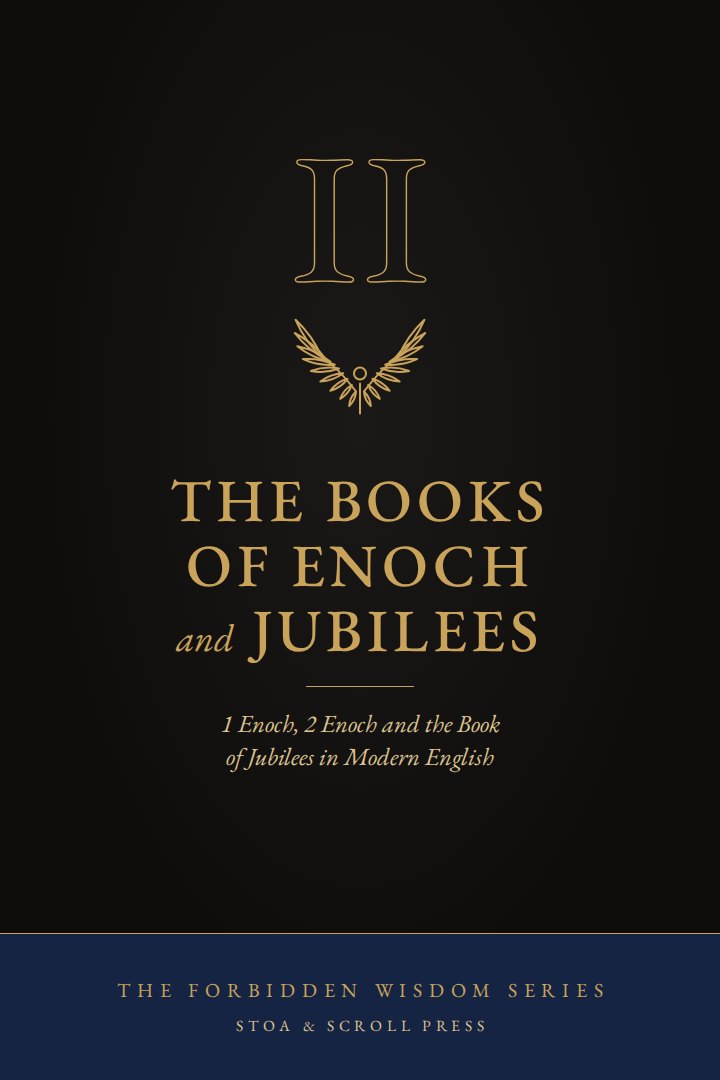
The classic English translation from the Ethiopic is the one by R.H. Charles. The Books of Enoch and Jubilees (Volume II of the Forbidden Wisdom Series) is an adaptation of Charles’s translation into clear contemporary English, not a new translation. It contains 1 Enoch and Jubilees, the two best known books of the Ethiopian canon, and also 2 Enoch, adapted from W.R. Morfill’s translation from the Slavonic.
While the rest of the world argued over which books to keep, a church in the mountains of Africa simply kept them. Everything we can read of Enoch today, we owe to that patience.